A brief history of the 16th century origins
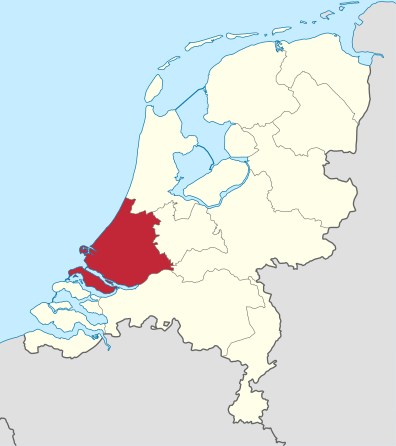 Location: The traceable origins of the generations DIJKSHOORN lie in the flat countryside bordering the North Sea. The area around what is now the city of Delft was originally a peat swamp sheltered from the sea by sand dunes. Peat was an important source of fuel for our early ancestors. The swamp was brought under cultivation by extracting the water and digging the peat. In doing so, the level of the land eventually fell below sea level. To continue living and farming the land it became necessary to construct earthen mounds or dikes (dijken) around these "polders" and then pumping the water out of the surrounded area. This pumping was performed by the use of windmills as a source of power. Ditches and canals criss-crossed the flat land to allow for drainage and create arable land rich in topsoil, which became ideal for market crops and farmland. As a matter of fact the nearest city of Delft got its name from this practice of digging (or in Dutch "delven") the canals and ditches. The area we are considering is roughly located in the south-western corner of the province of South Holland between Rotterdam, Hoek van Holland, Leiden and Gouda.
Probable origin of the name Dijkshoorn
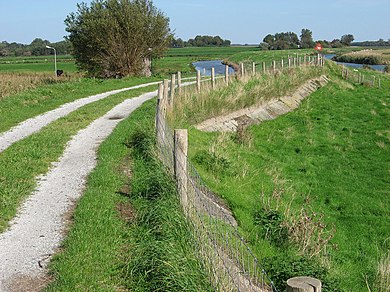 The name Dijkshoorn finds its possible origin in the fact that both home and harbour had to guard against public enemy No. 1 (Water). This also meant that the dikes had to be guarded (dike watches) by residents and their neighbours.
The Dikewatchers had to guard a certain length of dike during high water and were issued a hunters' horn during this service so that in case of problems the horn could be blown and heard above the storm.
These instruments, however, sometimes became plugged during summer or even became lost and therefore it was decided to make one person responsible for them and his status thus reflected this as his shield contained the "Fleurs de lys" with three hunter horns. The possibility also existed that this man could be a sheriff or magistrate as well. As time went by he would be acknowledged as Dijkshoorn.
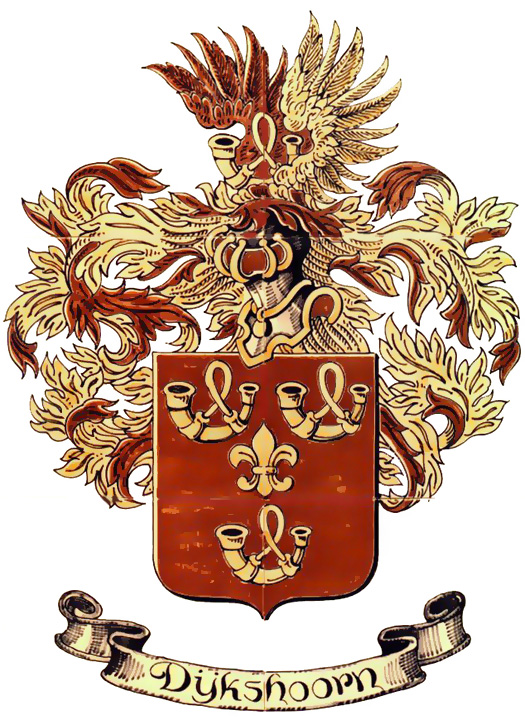 Heraldic Emblem: In red and gold lily accompanied by three golden hunter horns in the style of St. Hubertus. Helmet drawing: the hunter horn from the shield between a red and silver flight. Surrounding members: silver and red. Resting on the shield and attached thereto with two belts is a shining golden iron helmet slightly turned to the right. Around the helmet is a golden "secretrum" (family seal) hanging on a golden chain a symbol of steadfastness and dependency and a high understanding of freedom. Above the helmet is a wreath of leather pockets of horse hair in red and gold designed as a defense and repellant against sword attacks. Out of the top of the helmet surrounding the single hunter horn are two eagles' wings independent of each other in full flight symbolism.
Beneath the shield in a baroque script is the family name Dijkshoorn in a furled banner in the colours red and gold with the name in sable (black). Press the link to view a larger picture of the family shield.
Introduction: The genealogy described below commences with Pieter Cornelisz, from Voorschoten, province of Zuid Holland in the Netherlands, who left behind his widow Apolonia Arentsdr. After the death of her first husband this widow married her second husband, also named Pieter Cornelisz, and stayed on the property until it was dismantled during the disturbances (troebelen) around Delft, in the year 1572. It was during this period of time that Alva, the ruthless general for Philip of Spain, with an army of 10,000 mercenaries marched into the Netherlands to retain it as part of the Spanish crown and also to counter the inroads that Calvinism was making in the population as well as the leadership (States General). The death of her first husband was mentioned in an Act dated 18 May 1570 (RijksArchief, Hof van Delft 1892 no 9 litt. C.) and this is the first instance that mention is made that he was Pieter Cornelisz Op Dijcxhoren. It is also interesting to note that the place now known as Den Hoorn was first known as Dijkshoorn starting in 1370.
From this first marriage, four children survived: Blasius, Cornelis, Apolonia and Neeltgen. Cornelis continued to live at 't Woud, while Neeltgen married on 3 May 1592 to a brother-in-law of Blasius, namely, Philips Ijsbrantz Heemskerck, and moved to Honsholredijk.
 In spite of many attempts, it was impossible to go back further into time for this family tree. However, one gets the strong impression that Apolonia Arentsdr belonged to a very well known, well to do family of farmers, who parented other old families with names such as Veen and Fijck van der Hove (Rijks Archief Monster CXV-22, fo 155, d.d. 25 April 1615).
The family tradition of their own heraldic emblem (or shield) can be defended on the basis of this and later parentage notwithstanding the information below.
The notary public, Cornelis Dijxhoorn from Rotterdam, who belonged to this family tree and lived in the 19 th century, obtained a particular shield upon which the part of the family that is Dijxhoorn can lay a claim of an heraldic right, i.e. the above mentioned, one lily with three objects that look like hunter horns. In the Nederlandse Leeuw of 1884 mention is made on page 38 of a meeting between a women of the district and a farmer De Jong who lived near the church at 't Woud and she seemed to be knowledgeable about the existence of a Dijkshoorn shield.
An 18th century picture of the shield of Pieter Dijkshoorn, anno 1760 and 1761 a well-to-do man from Delfland a quite different heraldic emblem is shown. It shows a gold and black jumping unicorn supported by a green grass area with a left-leaning polderway in the shield footing. An illustration is available.
The name used varied, depending on the time and the personal observation of the writer. It was: Dijcxhoorn, Dijxhoorn, Dixhoorn, Dijckshoorn, Dijckshoren, Dijkshoorn, Dijkxhoorn, Dykshoorn, Dykshorn and Dykxhoorn.
Material provided by a Mr. A. Bijl Mz has been used in this genealogy. The family Dijxhoorn mentioned in Nederland's Patriciaat, 33e year, 1947, is now also included as part of this family tree.
Even though the roots of the Dykxhoorn clan (just to be using one name) are in the European lowlands, you will see that by the end of the 20th century they can be found beyond the Netherlands in Germany and also in North America. It will become especially challenging to maintain this family tree as the generations fan out across the world.